
Modern Dances
Dance with Soul, Rhythm and Emotion
Greek dance is not just movement – it is expression.
It is a way to speak without words, to feel, to remember, to free yourself. They are an integral part of cultural heritage, expressing emotions and history.
It is known that Greece has a dance history that begins 3,000 years ago. Greek dances such as the Hasapiko are an evolution of much older dances with roots dating back to 330 BC. This long history has given birth to hundreds of dances - today there are surviving records of four hundred different dances with their variations.
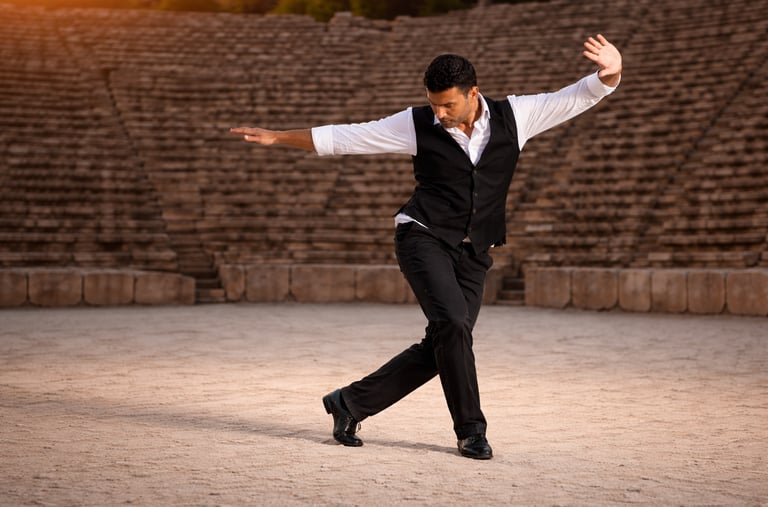
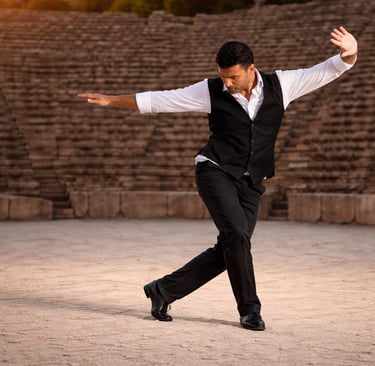
It is claimed that "the Zeibeki were Greeks mainly from Macedonia and Thrace, who followed Alexander the Great on his campaign into the depths of Asia. They were called Zeibekia, that is, livestock traders, because they slaughtered animals and sold them. Over the years, they wanted to immortalize their heroism and thus created this dance, the Zeibekiko, which they danced one by one with swords in their hands and sometimes in their mouths.
It is also said that the dance derives its origin from the Zeibeki order. A special minority of the population of Asia Minor, also called "knights of the mountains", were persecuted because of their delinquent behavior against state authority.
Zeimpekiko

The most important element that differentiates zeibekiko from other dances is its music and its lyrics. To dance zeibekiko you concentrate on both the music and its words. What you dance, that is, your movements, must be related to what you hear, the words of the song, their meaning, give you the tone and style...
What you hear makes you express yourself with your body and spontaneously dance your next move, your next figure.
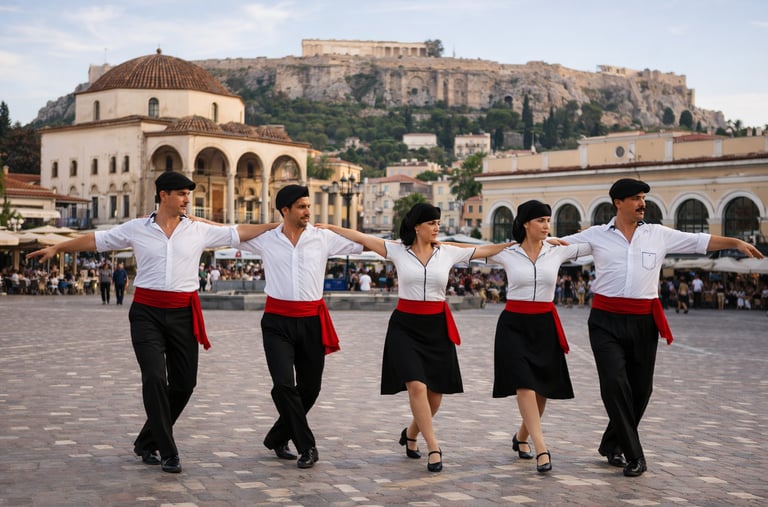
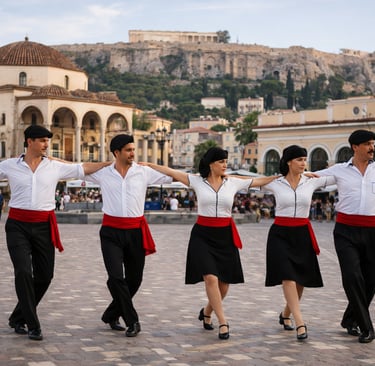
The butcher's dance has political origins. Its existence is due to the Byzantine dance of the butchers, which was danced in Constantinople, mainly by butchers during festivals. Most of them were unruly and walked around provocatively displaying their weapons and everyone was trembling.
Hasapiko

It is difficult to follow those who dance it, if you do not know the same steps. The butcher's dance requires that those who dance it know it well, since those who dance in the same line must make the same movement at all times, to the same rhythm.
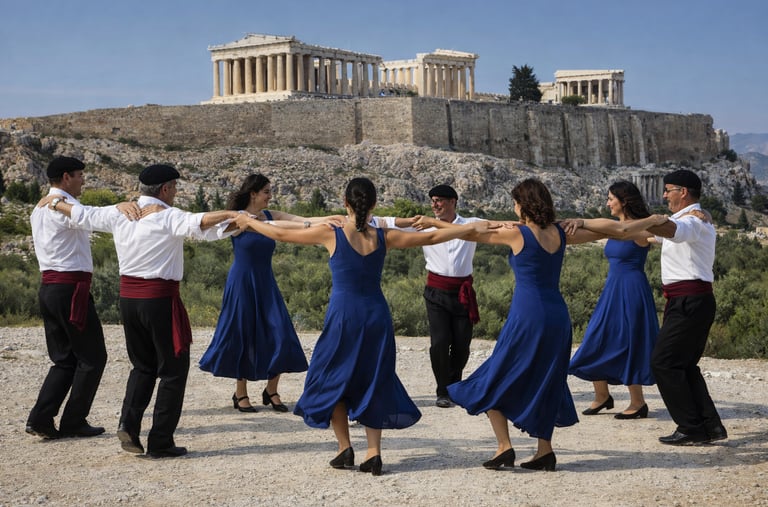
It is a dance of Slavic origin, as its name suggests, but there are variations of it in all the countries of the Balkans and Eastern Europe up to Russia (Casatschock)...
It was spread and shaped in Greece by the wandering musicians who migrated from Eastern Europe to the Mediterranean, to the ports of Asia Minor and Macedonia. These musicians spread the music and developed the dance in its various forms.
Hasaposerviko

The Hasaposerbikos dance is certainly the easiest, most cheerful group dance. It is distinguished by its liveliness and speed. Its many figures are distinguished by their speed and sometimes by their acrobatic difficulty.
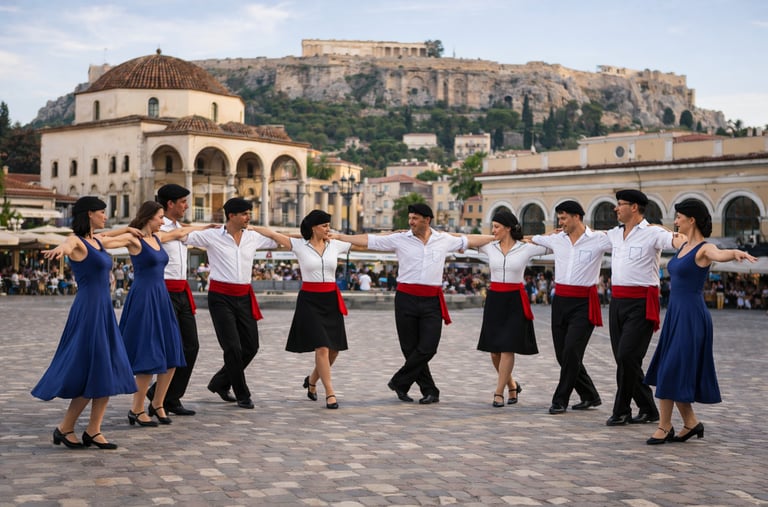
One of the most popular Greek dances, especially among foreigners around the world, thanks to the immortal music of Theodorakis in the film "Zorba the Greek" filmed in 1964.
Since then, there is no place on the planet where the music has not been heard and has not swept the world into an incessant applause...
Sirtaki

It has no connection with the old Greek musical and dance tradition. Its existence is due to the music of the film "Zorba the Greek". It is a dance that is danced to a choreography with movements from the Hasapiko, the Hasaposerviko and a variation of the Kalamatianos. In a combination of slow and fast movements - it is danced in continuous alternating formations of lines and circles by the dancers, with the most popular being the line (accordion) formations.


Its most likely origin is from Turkey. This is also revealed by the Turkish name of the dance, which means double-string. Tsifteteli is a sensual dance, which moves very little in steps, so the audience's gaze is focused on the swaying of the hips, the shaking of the chest, the movements of the arms and abdomen, the bending of the waist and generally on all the body movements that reveal sensuality and reveal the female femininity.
Tsifteteli

It is a common way for couples to flirt, since it is often danced in pairs, but also a means for groups to communicate, which is why it remains a very popular dance to this day. Modern tsifteteli is much more cheerful, happy and uplifting and is reminiscent of Arabic rhythms.
Follow us
to always be informed.
subscribe
© 2025. All rights reserved.
Created by


Menu